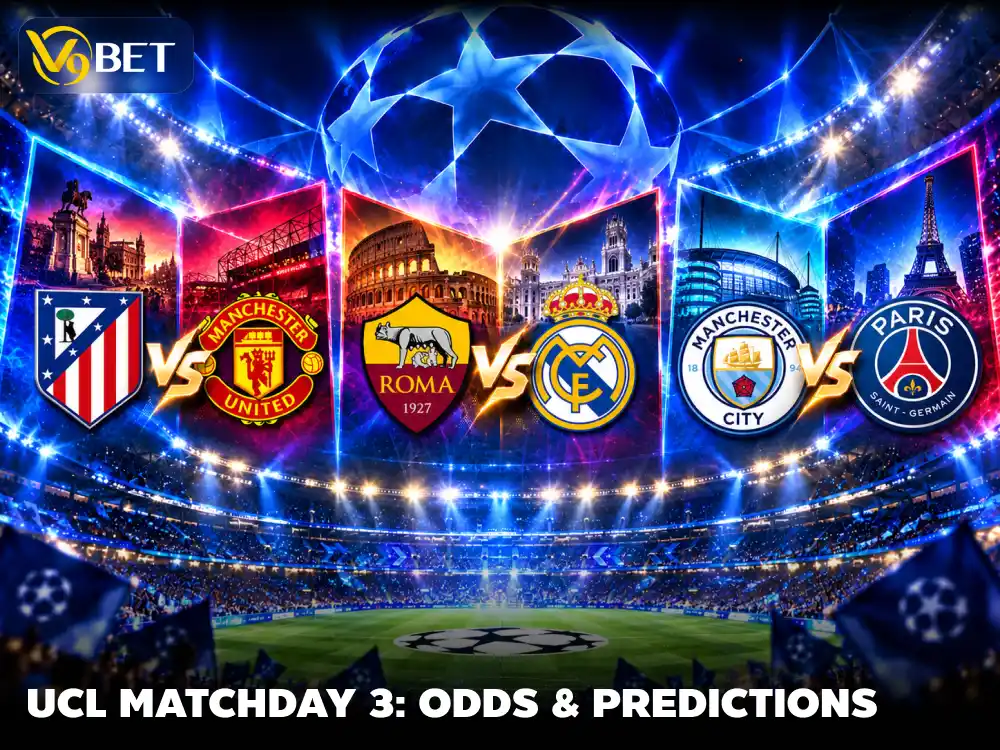
A big club faces a lesser-known opponent, the odds board leans clearly toward them, but when the starting line-up is announced, a few familiar faces are missing. Those who backed the favourite start to worry. Those who haven't bet yet think the underdog has just become more attractive. Both reactions are understandable, but neither answers the key question: how do those changes affect the way the team plays, and how much has the price already reflected them?
Analysing Champions League Matchday 3 odds needs to start from the gap between a club's reputation and the actual strength of the line-up on the pitch. Rotating many players doesn't always mean a heavy weakening; keeping almost the entire familiar line-up doesn't guarantee the expected rhythm either. In some matches the problem lies with the player who progresses the ball under pressure; in others it's the ability to defend the space behind the full-backs.
Matchday 3 of the 2026/27 season takes place on 20–21/10 according to the UEFA schedule. When there's no confirmed line-up and no verified odds board, the appropriate approach is to prepare the scenarios worth tracking. Recognising what could make your initial assessment wrong is more useful than picking a side in advance and then finding reasons to defend it.
Key Points to Remember
- Rotation should be assessed by tactical role and the quality of the replacement, not just by counting absent players.
- Matchday 2 takes place on 13–14/10, Matchday 3 on 20–21/10/2026. The one-week gap is a reason to check each team's schedule, not proof that any team will rest its key players.
- Handicap and payout are two pieces of information that must be read together. A falling price doesn't by itself prove the line-up is strong or that there's special information.
- Missing attackers doesn't automatically mean backing the Under; missing defensive links isn't enough to conclude the match will be high-scoring.
- The confirmed line-up tells you who starts, but doesn't guarantee the tactical setup or the timing of substitutions.
- Not understanding the price movement, not being able to determine the impact of rotation, or having exhausted your budget are all valid reasons to skip a match.
When Does Champions League Matchday 3 Take Place, and Why Look at Matchday 2 Too?
According to the season schedule published by UEFA, Matchday 2 takes place on 13–14/10/2026, while Matchday 3 is on 20–21/10/2026. The two rounds are a week apart, making the previous round's personnel usage a piece of information that needs updating. At the time of writing on 02/10, it's not possible to write as if the teams have already completed Matchday 2 or decided their line-ups for Matchday 3.
For readers in Vietnam, check each match's kick-off time in GMT+7. The date UEFA lists in the schedule shouldn't be used directly to infer the viewing date in Vietnam, because a match in the European evening can fall in the early hours of the next day. This article uses UEFA schedule dates and doesn't assign Vietnam times without cross-checking each match.
The gap between the two rounds is only part of the fitness picture. A team may still have a domestic match, travel, or players just back from international duty; the impact must be checked against the schedule and actual minutes. Don't infer from "the October calendar is packed" that every big club will rotate heavily. The line-up also depends on the points situation, the quality of replacements, and the coaching staff's priorities.
Those wanting to see Matchday 3's position within the whole phase can read more on the Champions League 2026/27 schedule and how to cross-check fixtures. When assessing a single match, you still need to return to the official schedule and the latest personnel data. A correct season schedule doesn't produce a correct line-up prediction by itself.
The Champions League Rotation Trap Lies in How News Is Interpreted
The "trap" in this article is the mistake of misreading information and therefore misjudging a bet, not a conclusion that bookmakers deliberately rig results. Rotation news easily triggers strong reactions because it directly relates to team strength. However, there's a big gap in certainty between an online line-up prediction and the official starting list.
"Could be rested" doesn't mean the player will definitely sit out. A statement about fitness management also doesn't confirm the player will miss the whole match, play few minutes, or just reduce training intensity. If your assessment depends on whether a key player starts, keep it conditional until there's confirmation. There's no need to turn a possibility into a fact just to lock in a bet early.
Counting Changes Is Easier Than Assessing Roles, But Usually Not Enough
Suppose a team replaces two wingers with options already familiar with the system. Speed, duels, or combination play may change, but the spine for progressing the ball from defence to midfield is preserved. Conversely, just one midfielder whose job is to receive the ball under pressure being absent can force the team to change its build-up. These two situations shouldn't be assessed by the number of changes alone.
What needs checking is whether the replacement can do a similar job. A player in the same position in the formation may not have the same way of receiving the ball, moving, or shielding space. If the backup striker tends to drop deep to link play while the starter prefers running behind the defence, the change can alter the whole chance-creation pattern. The handicap assessment then has to consider the ability to create a margin with the new style of play.
|
Position or Role Changed |
Question to Check |
Rushed Conclusion |
|
Midfielder who receives the ball and escapes pressing |
Who will link the lines, receive under pressure? |
Only one player missing so impact is small |
|
Centre-back or goalkeeper |
How does coordination, build-up, and space protection change? |
Defensive change means definitely back the Over |
|
Full-back |
Is attacking width and counter-attack protection maintained? |
This position doesn't affect the favourite much |
|
Chance creator |
Who plays the final pass or handles the ball before a low block? |
Keeping the striker is enough |
|
Striker |
Is the running, hold-up play, and pressing still suitable? |
A backup striker always makes the match low-scoring |
Having a Key Player on the Bench Doesn't Guarantee a Rescue
The bench list can show available options, but it doesn't tell you who will come on and when. Match events, fitness, and tactical decisions can all change the plan. When placing a bet based on the argument "they'll definitely bring the star on in the second half", the player is using an unconfirmed assumption to support the assessment.
Even if that player comes on, the remaining time and the opponent's structure also matter. A team already sitting deep to protect a lead can make the spaces completely different from the start of the match. Adding a famous name doesn't automatically fix conditions that existed when you were reading the pre-match odds. Re-read the match, don't just read the name of the player coming on.
Champions League Odds Today: Read Both the Handicap and the Payout
To understand odds movement, first establish whether the two prices belong to the same match, same market type, same line, and same display format. A lower payout isn't enough to call it a "better price". With the same decimal odds format and the same bet conditions, a lower odds figure means a smaller return if you win; assessing whether it's worth backing also requires considering the probability of the outcome.
The handicap can change at the same time as the price. If the favourite is required to win by a smaller margin, the condition for winning the bet has changed; but the payout may also have dropped. You can't just look at the easier handicap and conclude the bet is better overall. Similarly, a higher payout alongside a bigger margin requirement is a trade-off, not a free bonus.
When looking for Champions League odds today, a screenshot of the odds board needs a timestamp and market name. A screenshot from before the line-up was announced doesn't represent the price after it; pre-match prices certainly can't be used as current prices once the match is underway. This analysis doesn't give specific odds because no verified odds board exists for the options being discussed.
|
Movement Observed |
What Can Be Determined |
What Can't Be Concluded From the Board Alone |
|
Handicap unchanged, favourite's price changes |
The payout for the same bet condition has changed |
That rotation is definitely the cause |
|
Handicap moves so the favourite must win by more |
The requirement to win the bet has changed |
The favourite will win big |
|
Handicap moves so a smaller margin is required |
The new bet has different conditions from the old one |
The underdog definitely has the advantage |
|
Total goals line drops |
The Over/Under reference point has been adjusted |
Missing strikers are the only cause |
|
Price changes after the confirmed line-up |
Movement appeared after a news milestone |
All movement is due to one specific player |
To avoid misreading the price column or market type, V9Bet users can refer to how to read the SABA odds board. The key is to compare equivalent options. Don't combine a price from one platform with a handicap line from another and assume it's a bet you can place.
When Does Rotation Actually Make the Favourite Struggle to Cover the Handicap?
Rotation is a concern for the favourite when it reduces the ability to create and maintain the margin the bet requires. A team can still be strong enough to win the match but struggle to create enough quality chances, or struggle to keep pressing after taking the lead. So the question to answer is whether the new line-up can meet the handicap's requirements, not just which team is stronger.
Suppose the favourite retains possession ability but loses the player who plays through the lines. The opponent sits deep, blocks the central lane, and forces them wide. You might see the strong team control most of the match, but their attacks mostly end in crosses being cleared. The observation "dominating" then doesn't mean the ability to create a margin is as good as expected.
Another situation is a team taking the lead and then slowing down. If the starting line-up was chosen to manage energy and the team doesn't need to push high at all costs, the handicap backer can end up in a state of being right about who wins but failing the bet's requirement. This is just a tactical possibility to factor in, not a rule that any rotated team will stop attacking after taking the lead.
The underdog doesn't automatically become a good choice either. If they lack ball retention, keep losing the ball near their own box, or can't exploit the spaces the opponent leaves, the favourite's changed line-up may still be enough to create pressure. Both sides and the current price must be assessed. Identifying a problem with the strong team is only part of the job.
Over/Under After Line-Up News: Why Missing Strikers Isn't Enough to Back the Under
Total goals depend on both teams' scoring chances and how the match might open up. Missing an attacking player can reduce one side's finishing ability, but changes in midfield or defence can also cause them to lose more control. Backing the Under purely from the list of absent strikers ignores the rest of the match.
Suppose the favourite changes its tempo-setting midfielder and both full-backs. Build-up may be less fluid, but they also risk counter-attacks into the new spaces. A match with few beautiful combinations can still produce clear chances from turnovers or positional errors. Conversely, two teams keeping their attackers doesn't guarantee many goals if both prioritise risk control.
The current Over/Under line must be brought back into the comparison. If the market has dropped the line significantly after the personnel news, a new Under bet no longer has the same conditions as one made before. Players can easily be right about the direction of impact yet misjudge the adjusted price. A correct assessment doesn't mean every betting moment is equally worthwhile.
With first-half odds, an extra specific reason about how the teams start is needed. A line-up with little familiarity can take time to gel, but can also make early mistakes. Don't switch to a first-half Under just because the full match feels too hard to call. Changing markets doesn't make the missing information disappear.
What Questions Should Be Asked About Matchday 3 Fixtures Before Looking at Prices?
UEFA's official fixture list includes Manchester City–AEK Athens and Paris Saint-Germain–Barcelona on 20/10, Bayern München–Arsenal and Como–Manchester United on 21/10. These pairings create different tracking contexts; selecting them here doesn't imply any team has confirmed rotation or has specific odds available.
With Manchester City–AEK Athens, the thing to avoid is inferring a margin from brand familiarity. Before considering the favourite, check the actual line-up, chance creation, and handicap conditions. With Como–Manchester United, the away team's reputation also doesn't replace an assessment of how they'll operate away from home. These questions remain valid whether the eventual starting line-ups change a little or a lot.
In Paris Saint-Germain–Barcelona and Bayern München–Arsenal, check the balancing roles when personnel changes occur. If a team changes the player who receives the ball under pressure or protects the space behind midfield, the impact can be in how they escape pressing and defend transitions. This is a conditional analytical direction, not a confirmed tactical description of the four teams on Matchday 3.
To place a single-match assessment within a broader picture, you can refer to how to assess teams in the Champions League league phase. However, assessing long-term strength and choosing a bet for one match night are two different tasks. A season-long view shouldn't replace close-to-kick-off data.
Wait for the Confirmed Line-Up or Wait for Live Odds?
Waiting for the confirmed line-up suits situations where the assessment depends heavily on an unconfirmed position. Waiting for live can help verify how that line-up actually operates. Both choices have trade-offs: you gain information, but the price may change and no longer match the original moment. No timing is always best for every match.
|
Timing |
Information You Can Check |
Remaining Gap |
Approach |
|
Before line-ups are out |
Schedule, confirmed personnel news, expected options |
Who starts and the actual setup |
Keep assessment conditional |
|
After line-up announcement |
Starters, bench list |
Combination play, intensity, substitution plan |
Reassess roles then cross-check the new price |
|
Once the match is underway |
Escape from pressing, chance creation, counter defence |
Observation sample still short, flow can change |
Avoid inferring from a few plays |
|
After a goal or substitution |
Match state and personnel have changed |
The next tactical response |
Rebuild the assessment for the current conditions |
After the confirmed line-up, review your original reason before looking at the price movement. If you intended to back the favourite because of their central attacking ability, but the new line-up changes the player in that role, adjust the reasoning. Don't keep the same conclusion and only change the stake. Clarity about the line-up is useful when it helps you accept that an option no longer fits.
When watching live, focus on build-up quality rather than just possession percentage. Is the team getting the ball into dangerous areas in favourable positions? Does the receiver have a passing option or is he forced to turn back constantly? After losing the ball, do they maintain the spacing to stop counter-attacks? These questions connect directly to the impact of rotation.
If the strong team presses, wins a few corners, but most situations come from blocked crosses outside the box, that's not enough to confirm a goal is coming. Corner counts and pressure on the goal have a relationship depending on the match flow, but no single metric replaces a full assessment of chances. Nor should a few good minutes be used to deny all the personnel issues seen pre-match.
You can read more on how to follow live Champions League odds on V9Bet. When looking at prices on any platform, check the score, time, and market type right on the bet slip. Match images can lag behind updated data; a situation you just saw may no longer correspond to the previous price.
Champions League Betting Analysis Needs a Condition for Rejection
A useful assessment must state when you'll no longer believe in it. If you expect the favourite to keep creating chances despite rotation, the condition for review might be the team failing to play through the pressing line or the replacement constantly receiving the ball in isolation. Having specific conditions helps you avoid explaining every event in a way that defends the bet you've already chosen.
Suppose before the match you believed that as long as the spine is maintained, the favourite will operate fine. After the line-up is announced, both the ball-receiving role and the coordinator change. At that point, the original assessment needs to be rewritten. The price becoming more attractive numerically doesn't compensate for the football basis that has been lost.
If you've already placed a bet, don't assume an opposite bet or a live bet will fix the earlier decision. Additional bets create new obligations and risks, and may use a different handicap line or settlement window. Before doing anything else, calculate the total money at risk and check whether you have an independent new argument or are just trying to reduce the feeling of exposure.
Managing Capital When Multiple Champions League Matches Run at Once
The limit for the whole match night matters more than the feeling that each individual bet is small. If many bets rest on the same argument like "big clubs rotating will still win comfortably", you're repeating the same assumption across multiple matches. Splitting money into many slips doesn't necessarily make the assessment more diverse, and the total amount at risk still needs to be added up fully.
Suppose you set aside one million VND as the limit for one tracking night. That amount doesn't have to be used. If you've already bet pre-match, the money reserved for live decisions must sit within the same limit rather than being treated as a new budget. When one match generates several additional bets, look at the total money on that match before thinking about opportunities in another.
A losing streak doesn't make the next bet more worthy of an increased stake. After an unfavourable result, the mistake often appears when the player switches to another match just because it's still running, skipping the steps of checking the line-up and price type. A match you haven't researched doesn't become suitable just because you want to end the night back at break-even.
Staying out should also be viewed as a result of analysis. You might understand the impact of rotation but the price has already moved too much; or the line-up is so different from expectations that you no longer have a basis. Analysing Champions League Matchday 3 doesn't mean having to pick a bet for every fixture. Knowing how to eliminate a match is how you protect the quality of the remaining decisions.
Frequently Asked Questions
When does Matchday 3 of the 2026/27 Champions League take place?
According to the UEFA schedule, Matchday 3 takes place on 20–21/10/2026. When following from Vietnam, check each match's kick-off time in GMT+7, because an evening match in Europe can take place in the early hours of the next day in Vietnam. Don't use the European schedule date as the default viewing date.
If the favourite rotates heavily, should I back the underdog?
That can't be concluded just from the number of changes. Assess the role of the absent players, the quality of replacements, the opponent's style, and the current handicap. The underdog is only worth considering when the reasoning fits the bet conditions, not just because unfavourable news appeared for the favourite.
Does odds falling after the line-up announcement signal a certain win?
No. The movement tells you the price has changed, but doesn't guarantee the result or confirm the cause. With the same conditions and decimal odds format, a falling price also means a smaller return if you win. Reassess the whole option at the new price.
If the main striker is missing, should I back the Under immediately?
Don't choose based on one piece of information. Consider the remaining chance creation, both teams' defensive structure, and the current total goals line. If the price has already reflected the personnel news, an Under bet after the adjustment can be significantly different from one before it.
How many minutes of live action are enough to assess a rotated line-up?
There's no fixed number of minutes that guarantees enough data. What matters is whether you've observed situations related to your assessment, such as build-up under pressure and handling after losing the ball. An early goal or red card can change the context immediately, requiring you to review earlier observations.
Does this article give betting picks or confirmed line-ups for Matchday 3?
The article focuses on methods for identifying the impact of rotation, with fixtures cross-checked against UEFA. Personnel scenarios are presented as hypotheses; there is no odds table or confirmed Matchday 3 line-up verified in the article. As match day approaches, update the data before deciding.
Expert Conclusion
Analysing Champions League Matchday 3 odds should follow this order: verify personnel information, assess the roles that change, then cross-check that impact against the bet conditions and price. Looking at team names first, then at rotation news, then reacting to odds movement easily leads to a choice with a weak foundation. The deciding point is whether the actual line-up can produce the match flow the bet requires.
Matchday 3 hasn't arrived yet, so there's no need to turn personnel predictions into firm conclusions. Prepare the conditions to track, accept revising your assessment when the line-up differs from expectations, and keep the total budget consistent across the whole match night. If after all that you still can't explain why the current price is reasonable, skipping the match is a complete decision.