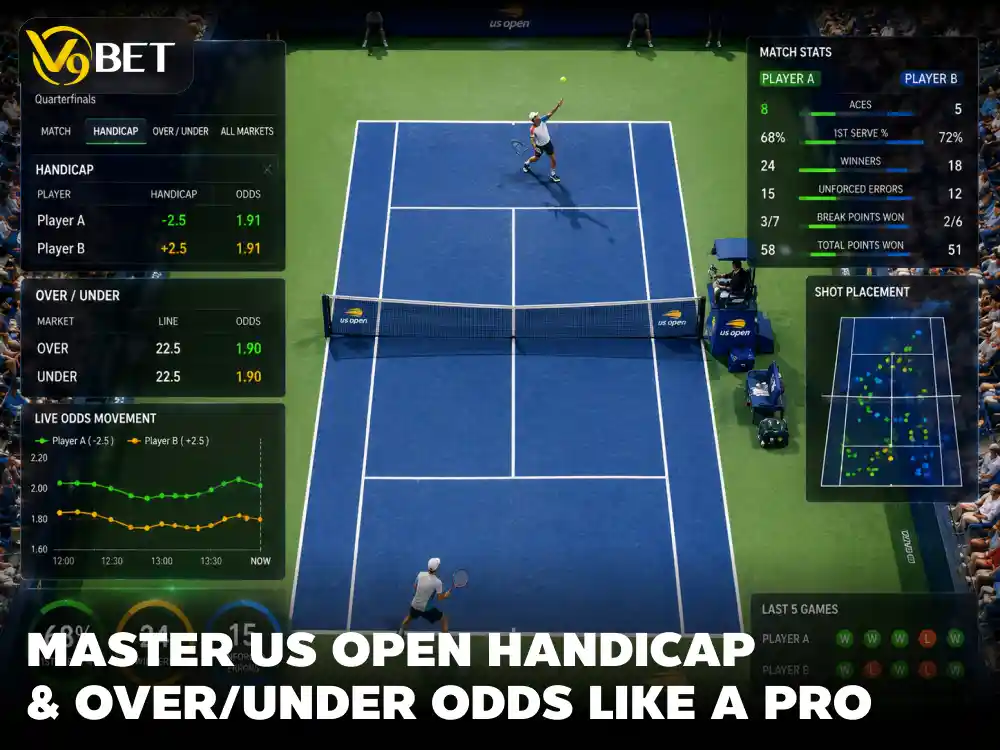
Master the US Open 2026 Handicap and Over/Under Betting Formula: Calculate Odds Like a Pro
Tennis betting isn't just about picking the match winner. In matches where the favourite clearly outclasses their opponent, the win odds can be too low to be attractive. However, choosing a game handicap or the over/under on total games can add much more depth to your analysis. But to play these markets effectively, you need to understand the math behind them. Simply picking the correct winner doesn't guarantee that your handicap or over/under bet will win.
Especially as we approach the US Open 2026, a hard-court Grand Slam featuring the world's best players, having a pre-match score projection is incredibly useful. The favourite might win as expected, but if each set is tight, finishing 7-6 or 6-4, a high handicap might not cover. Conversely, if the match ends quickly with scores like 6-2, 6-3, an Over bet that looked appealing before the match could lose, even if you correctly picked the winning player.
The key is to shift your question from “Who will win?” to “What will the final scoreline look like?” Then, compare that projected scoreline against the handicap and over/under lines set by BTi on V9Bet.
For example, if you predict Player A will win 6-3, 6-4, the total game difference is 5. This immediately gives a different meaning to seeing a line of A -3.5 versus A -5.5. Similarly, for an over/under line of 21.5 games, if your projected total is only 19 games, your analysis naturally leans towards the Under.
This article will guide you through the core calculation methods, from reading handicaps based on scorelines and calculating total games, to the additional factors you should consider before placing a bet on V9Bet. The goal is to make each betting line more meaningful than just looking at the payout odds.
Understanding US Open 2026 Handicaps Before You Bet: What Do -2.5, -3.5, and +4.5 Mean?
Game handicaps in tennis are calculated based on the “total games won in the match,” not just who wins the match. For instance, if Player A is favoured at -3.5 games, it means that when the match ends, you subtract 3.5 games from the total games A won, then compare that number to the total games B won. The bet wins if the resulting figure is still higher than B's total.
Let's use a simple example. Player A wins 6-3, 6-4. A has won a total of 12 games, and B has won 7 games. The difference is 5 games. Therefore, a bet on A -3.5 wins because the winning margin (5) is greater than 3.5. However, if the line was A -5.5, the same score would be a loser, as the actual margin is only 5 games.
This immediately shows that “picking the winner correctly” and “picking the handicap correctly” are two entirely different things.
Another example: If Player A wins 7-6, 6-4, the total games are A: 13, B: 10, making the difference only 3 games. If you bet on A -3.5, even though A won the match, your handicap bet loses. Conversely, a bet on B +3.5 would win under these conditions.
This is why, before backing a seeded player in the US Open 2026, you must ask yourself: Does this player have the potential to “win big” or just a “high chance of winning”? If the opponent has a strong serve and holds their serve tenaciously, even if their chance of winning the match is low, they can keep the score close enough to cover the handicap as the underdog.
On V9Bet, you should compare the different BTi lines rather than just looking at the odds. For example, -2.5 might pay less than -4.5, but the conditions to win are easier. Deciding which line is “worth it” requires evaluating both the handicap and the payout odds together.

Watch the US Open in style like never before. Bet at V9Bet.
A Simple Formula to Calculate Game Handicaps from Real Scores at the US Open 2026
The basic calculation is easy to remember: Add up the total games each player won in all sets counted under the market rules. Then, find the difference and compare it to the chosen handicap.
Let's say Player A is favoured at -4.5 and the final result is:
A wins 6-2, 3-6, 6-2
A's total games: 6 + 3 + 6 = 15 games
B's total games: 2 + 6 + 2 = 10 games
Difference = 5 games
So, A -4.5 wins because the actual difference (5) is greater than the handicap (4.5).
Interestingly, even though A dropped a set, they still covered -4.5 because the two sets they won created a big enough margin. This shows that game handicaps aren't decided by sets alone.
Conversely, let's say Player A wins in straight sets 7-6, 7-6. The total games are A: 14 and B: 12, a difference of only 2 games. Despite winning the match in straight sets, a bet on A -4.5 would lose.
So, before placing a bet on V9Bet, try creating 2-3 possible scorelines you envision and calculate the difference. If most of your projected scores still cover the BTi line you see, that line might align better with your analysis than one that requires a blowout win in only one scenario.
US Open 2026 Over/Under Formula: How to Calculate Total Games to Know if Over or Under Wins
The Over/Under market uses a different principle. It doesn't matter which player wins; instead, it's all about the total number of games played in the match. If the line is 22.5 games, the Over needs at least 23 games to win (under standard market rules), while the Under needs the total to be no more than 22 games.
For example, if a match ends 6-4, 6-4, each set has 10 games, for a total of 20 games. Therefore, Under 22.5 wins, while Over 22.5 loses.
If the match ends 7-6, 6-4, the total is 13 + 10 = 23 games. This means Over 22.5 wins. You can see how just one tiebreak set can instantly change the outcome of an Over/Under bet.
Or, if the match goes to three sets, like 6-3, 4-6, 6-4, the total games are 9 + 10 + 10 = 29 games, which is well over a line of 22.5.
Therefore, what Over/Under bettors need to analyse isn't just whether the match will be “close” but to translate that closeness into a number of games. If you believe there's a chance of tiebreaks or dropped sets, the total games are likely to increase. Conversely, if the favourite is expected to win convincingly, say 6-2, 6-3, the total games will be around 17.
When looking at the market on V9Bet, start by creating a range of possible scores, e.g., thinking the match might end with around 21-24 total games. Then, see where the BTi Over/Under line is set—at 21.5, 22.5, or 23.5. A shift of just one game can make one side much more appealing.
Also, always check the specific rules of the market you're betting on, especially regarding player retirement or matches not being completed. Bet settlements depend on the market's and provider's rules. You shouldn't apply the standard calculation method to every situation without checking first.
Tiebreaks and Three-Set Matches: Key Variables that Push Total Games Higher
Tiebreaks have a massive impact on the Over/Under market. A set ending 7-6 produces 13 games, compared to a set where the favourite wins 6-2, which only has 8 games. A difference of five games from just one set can turn an Under bet into an Over bet.
So, a match where both players have strong serves and are hard to break should be evaluated differently from a match where one player has a clear return advantage. If both players hold serve consistently, the chance of seeing scores like 5-5, 6-6, and tiebreaks increases.
Three-set matches are just as important. Consider an Over/Under line of 38.5 games for a potential three-setter. If the match is a quick blowout, the Over faces a tough challenge. However, if there are tight sets or the players split sets, the total games can rise very quickly.
Bettors should therefore separate the question of “who will likely win” from “how long will the match be”. A favourite can win and the Over can win simultaneously if the sets are close. Likewise, a favourite can win and the Under can win if they close out the match decisively.
When looking at odds on V9Bet, compare the different BTi lines available. A lower total line might be easier to hit but comes with different odds, while a higher line offers another set of conditions. The best choice comes from comparing your “projected game total” with the “market price”, rather than just picking Over or Under based on a feeling.

Conveniently bet on the US Open tennis tournament anytime, anywhere with V9Bet.
Comparing Handicaps vs. Over/Under: Choosing the Market that Best Matches Your Score Projection
Once you understand the math for both markets, the next step is choosing which one aligns better with your analysis. Even though you're using the same player data, these two markets are asking different questions.
If you're confident Player A is clearly superior in service, return, and hard-court form, a handicap might be more suitable. You're betting on the “gap” between the two players. For example, predicting A will win 6-2, 6-3 means you see a blowout coming, making a game handicap a logical choice.
However, if you think the match will be close and aren't sure who will win, the Over/Under market might be a better fit. Suppose you expect to see a 7-6 set or a split in sets. What you're confident about might not be the winner, but the length of the match. In this case, the Over/Under takes the winner's name out of the equation.
The easiest method is to create 2-3 hypothetical scorelines. For example: 6-3, 6-4 / 7-5, 6-4 / 7-6, 4-6, 6-3. Then, calculate both the game difference and the total games for each scenario. See which angle appears most consistently.
If every scoreline shows Player A winning, but some show a tight win and others a blowout, a high handicap might not be the best bet, even if A is a reliable pick to win the match. On the other hand, if several scenarios produce a total games number that exceeds the BTi line, the Over market has a stronger analytical foundation.
The key is not to start with “I want to bet the favourite” or “I'll bet the Over today” and then look for data to support it. You should start with the expected match flow and scoreline. Let the numbers tell you which market best aligns with your analysis.
On V9Bet, having multiple markets lets you compare them side-by-side on the same match page. This is where understanding the basic formulas helps you clearly see the differences between the odds, so you don't just pick the one with the higher payout.
Read more: US Open 2026 Tennis Kick-off: All-In-One Live Betting and In-Play Odds
Create Mock Scores Before Betting: An Easy Way to Find Odds that Match Your Analysis
Creating mock scorelines isn't about predicting the exact result, but about establishing a plausible range. For instance, if your analysis says the favourite is better, but the opponent has a good serve, you might create three scenarios: 6-4, 6-4 / 7-5, 6-4 / 7-6, 6-4.
Then, calculate the game difference for each case. If the difference is mostly between 2-4 games, a line of -5.5 goes against your analysis, even if you believe the favourite will win.
Next, calculate the total games. If your three scenarios are around 20, 22, and 23 games, and BTi has set the line at 18.5, betting the Under would be contradictory. Conversely, if the line is 24.5, your perspective shifts immediately.
This method helps separate analysis from emotion and player reputation. Once you translate your thoughts into numbers, it becomes clear what kind of match result is needed for a market line to win.
For a major event like the US Open 2026, which has both heavily favoured seeds and tight, evenly-matched contests, using this method before checking the BTi odds on V9Bet helps you choose markets systematically. This is especially valuable on days with many matches, preventing decisions based solely on player names.
Reading Odds, Alternative Lines, and Live Prices for the US Open 2026 Before You Bet
After calculating handicaps and game totals, the next step is reading the “odds” correctly. Even if you choose the right market type, if the specific line doesn't match your analysis or the odds aren't worth the risk, the betting outcome may not be as satisfying as you hoped.
For example, if Player A is at -3.5 and there are also alternative lines available at -2.5 and -4.5, the -2.5 line is easier to win but might have lower odds, while -4.5 pays more because it requires a more decisive win. You must ask yourself which line your projected scoreline is most likely to cover, not just choose the one with the best-looking payout odds.
The same principle applies to Over/Under. If you think the match will have around 22-23 games, lines at 21.5 and 23.5 present very different propositions. Betting Over 21.5 might have lower odds but gives you more room to win, whereas Over 23.5 requires a longer match for a potentially higher return.
For live betting, the movements during the match require even more careful reading. Suppose the pre-match Over/Under was 22.5, but early on, both players are holding serve well. The line might shift up to 23.5 or 24.5. A rising line doesn't automatically mean you should chase the Over, as the market has already adjusted to the new situation.
Another case is if the favourite gets broken early. The live handicap might drop from -4.5 to -2.5, which looks “cheaper.” But you need to consider whether this change reflects a genuine decline in form or just a temporary blip. If the player is still serving well and starting to pressure the opponent back, the live price might offer an angle. However, if they're clearly on the back foot, the lower line doesn't automatically make the bet attractive.
On V9Bet, comparing the multiple BTi lines allows you to make a more precise selection. The key is to let your analysis lead the way, never the odds. Once you know your projected score, choose the line that best fits that view and a risk level you're comfortable with.
How to Compare Alternative Lines Before Placing a Bet: Don't Just Pick the Highest Odds
Higher odds usually come with stricter conditions. For example, A -2.5 might pay less than A -4.5, but the -4.5 line requires the player to win by at least 5 games. This means a scoreline like 6-4, 6-4 isn't enough, even if A wins in straight sets.
So, before selecting a line, revisit your mock scorelines. If most scenarios show a difference of only 3-4 games, picking -4.5 just because of the higher odds is essentially betting against your own analysis.
The same logic applies to Over/Under. If you expect around 22 games but pick Over 23.5 to get better odds, you must understand that you're now requiring the match to be at least two games longer than your primary expectation.
Therefore, using alternative odds effectively isn't about finding the highest number. It's about choosing a level that offers a balance between the probability of winning and an acceptable return. With BTi on V9Bet, having multiple lines lets you fine-tune this balance. That's why you should always consider both the handicap number and the payout odds before placing your bet.

V9BET offers a wide range of betting options for US Open tennis fans.
Conclusion
To get more out of tennis betting, you shouldn't just look at who's the better player. You need to translate your view of the match into concrete numbers: the game difference and the total games. These two markets have different conditions, even when using the same match.
Handicaps are best for situations where you believe one player is clearly superior and likely to create a significant score gap, for example, predicting a 6-2, 6-3 win where the game difference is large enough to cover the handicap. But if you expect a 7-6, 6-4 win, even if the favourite wins, a high handicap might not be the best choice.
Over/Under is more suited for analysing the “match length”. If both players have strong serves, leading to tiebreaks or split sets, the total games trend upwards. Conversely, if the favourite can break serve consistently and close out sets convincingly, the Under market makes more sense.
For the US Open 2026, the variety of players means there are both very one-sided matches and very tight top-level contests. Using 2-3 mock scorelines before betting helps clarify which market to choose and which specific line best fits your game analysis.
Don't overlook the odds and alternative lines. Lines that are easier to win generally pay less, while those with higher potential returns require tougher conditions. So, never choose based on payout odds alone. Always compare them to your projected game difference or total games.
Live betting works on the same principles. Even though BTi odds change throughout the match, a shifting line doesn't always signal value. You must consider if the change matches what's happening on court. If the favourite gets broken but is still in control, the live odds offer one context. If they're clearly under pressure, a seemingly better line might just be reflecting a genuine increase in risk.
When betting through V9Bet, a key advantage is seeing handicaps, game totals, alternative lines, and live markets all from BTi for the same match. This lets you compare and make a decision without being locked into one market type.
In summary, for a systematic analysis of the US Open 2026, start by envisioning the match flow, create mock scores, calculate game differences and totals, and then compare them against the lines and odds offered by V9Bet. This approach won't guarantee winning bets, but it will make your betting decisions clearer and more reasoned, reducing the chance of placing a bet just because you see a big name or an attractive-looking price.